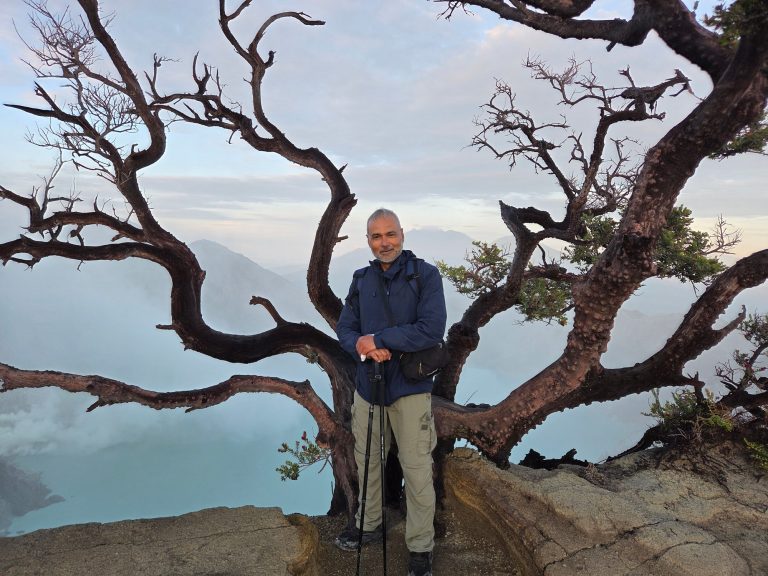
The name Sano Nggoang comes from the Kempo language of this part of Flores. Sano means lake. Nggoang means lit, or glowing. The lake that glows. Standing at its edge for the first time, you understand why someone chose that word.
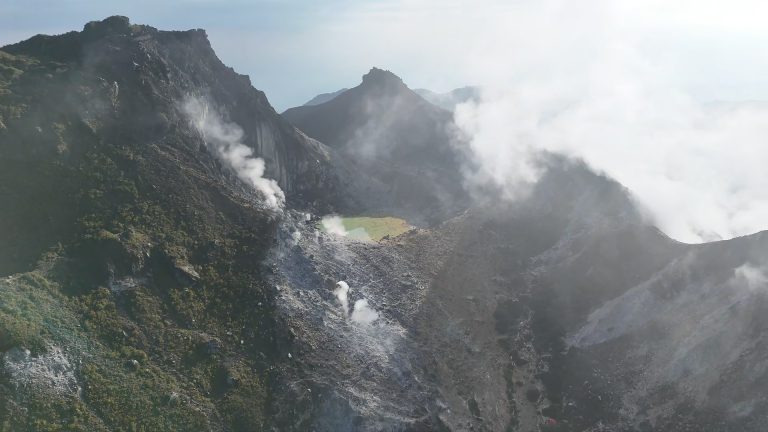
Sano Nggoang sits in the caldera of Wai Sano, the westernmost Holocene volcano on Flores Island, its waters occupying an elliptical depression roughly three and a half kilometres by two and a half kilometres across. The caldera formed through collapse following eruptions thousands of years ago. What filled it is a lake covering around 2,000 hectares, its depth not precisely measured but considered among the deeper volcanic lakes in Indonesia. Two solfataras mark the southeastern shore. Hot springs vent along the water’s edge. The smell of sulphur is present but not overwhelming, a background note rather than an assault, the volcano exhaling quietly into water it has been heating for millennia.
This may be one of Indonesia’s best kept secrets. And the road makes sure it stays that way.
From Labuan Bajo the distance is roughly 60 kilometres, but distance is not the relevant measure. The Trans-Flores highway takes you south for most of the journey. After that, with about 15 kilometres remaining, the road stops being a road. What replaces it is exposed rock, loose soil, gradients that a motorbike navigates at nine or ten kilometres per hour because that is as fast as it is safe to go. You do not arrive at Sano Nggoang. You earn it. The journey from Labuan Bajo takes around two hours, and the final section, on a sturdy motorbike, leaves you in no doubt about why this place sees so few visitors.
The villages along the lake’s edge are small and Catholic, as much of this part of Flores is. The Manggarai people here accepted Christianity early and kept their own identity intact alongside it. When I arrived, I was welcomed with the instinctive generosity that genuinely poor communities often extend to strangers more readily than wealthy ones do. There were no tour guides, no information boards, no infrastructure of any kind oriented toward visitors.
There were children.
They were playing by the lake when I arrived, as children play everywhere in the world, and they appointed themselves my guides without being asked and without any common language beyond gesture, a few words of Bahasa, and the universal grammar of pointing at things that matter. They showed me the gas emissions rising from the water. They showed me where the ground was warm underfoot near the shoreline. They showed me the boiling spring, leading me to it with the proprietorial pride of people showing you something they consider theirs, which it is. We spent two hours together. I flew my drone over the lake while they watched the screen with the concentration of people seeing their home from above for the first time. They told me everything they knew, in sign language and fragments of shared vocabulary, and it was more than enough.
When I left, the goodbyes brought tears to my eyes. Not from sentiment about remote places or noble poverty or any of the clichés that travel writing reaches for. From something simpler. The genuine warmth of people who had nothing particular to gain from being kind to a stranger and were kind anyway, completely, without calculation.
Sano Nggoang does not appear on most itineraries. The road ensures that. The lake itself is extraordinary, one of the larger volcanic crater lakes in eastern Indonesia, sitting in a caldera surrounded by forest that harbours endemic birds found nowhere else on Earth, including the Flores Monarch, the Flores Scops-owl, and the Flores Crow. The volcanic system beneath it is not dead. The solfataras and hot springs are its visible breath.
But what I think about most, when I think about Sano Nggoang, is not the geology. It is the children at the edge of the water, and the way they waved.
Copyright © Tales from the Horizon, 2025