Fifty kilometers south of Kyushu’s Satsuma Peninsula, something monstrous lurks beneath the East China Sea. Not a creature from mythology but a geological reality more terrifying than any sea dragon: Kikai Caldera, a nineteen-kilometer-wide scar in the seafloor marking the site of the most powerful volcanic eruption in the Holocene epoch, an event that seven thousand three hundred years ago very nearly erased human civilisation from southern Japan.
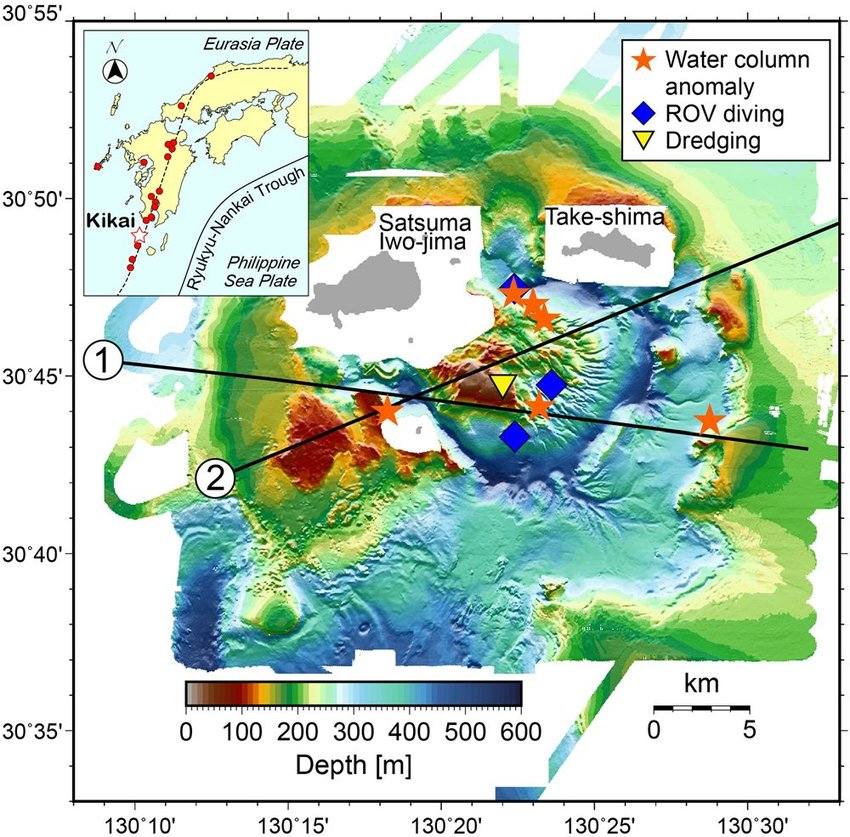
Most calderas offer the courtesy of visibility. You can stand on Santorini’s rim and gaze across sun-dappled waters to contemplate a Bronze Age catastrophe. You can drive across Yellowstone without realising you’re inside a supervolcano. But Kikai hides its menace beneath waves, a submarine feature that reveals itself only through bathymetric mapping and the testimony of rocks scattered across Japan’s southern islands. The caldera itself measures approximately twenty kilometers east-west by seventeen kilometers north-south, a twin ovoid depression in the seafloor where the Philippine Sea plate descends beneath Eurasia, where subduction generates magma, where pressure builds over millennia until the crust can no longer contain what churns below.
Seven thousand three hundred years ago, when the first cities were rising in Mesopotamia and Britain’s Stonehenge was still a dream generations away, Kikai detonated with enough force to alter the trajectory of Japanese civilisation.

The Akahoya Cataclysm
The Kikai-Akahoya eruption (named for the distinctive orange-brown tephra layer it produced) achieved a Volcanic Explosivity Index rating of 7. Recent detailed surveys of submarine pyroclastic deposits surrounding the caldera have revised upward previous estimates of the eruption’s magnitude. The total volume expelled now stands estimated between 332 and 457 cubic kilometers, with dense-rock equivalent volumes of 133 to 183 cubic kilometers. This makes it, unequivocally, the largest volcanic event since the glaciers retreated and the Holocene epoch began some 11,700 years ago.
To comprehend such numbers requires translation into consequences. The eruption began with Plinian phases: towering columns of ash and pumice rising through the troposphere, the stratosphere, reaching heights exceeding forty kilometers, where the atmosphere thins to near-vacuum and the sky fades from blue to black. These initial phases alone would have been catastrophic, raining pumice across southern Kyushu, burying landscapes in meters of volcanic ejecta. But the Plinian eruptions were merely the overture.
What followed was horror on a scale that beggars description. Because Kikai’s vents lay beneath the ocean, the contact between ascending rhyolitic magma and seawater created what volcanologists term phreatomagmatic explosions: steam-driven detonations where superheated water flashes to vapor, expanding with violence that shatters rock into finest ash and propels it outward at velocities that make hurricane winds seem gentle. The eruption column collapsed repeatedly, generating pyroclastic density currents that did something few land-based flows ever manage: they traveled across open water.

Pyroclastic flows respect neither land nor sea. Superheated mixtures of gas, ash, and rock fragments can achieve densities that allow them to skim across water surfaces, their bases riding on cushions of steam where seawater flash-boils beneath them. The Akahoya pyroclastic flows traveled up to one hundred kilometers from source, reaching the southern tip of Kyushu, engulfing Tanegashima and Yakushima islands, depositing ignimbrite sheets up to twenty meters thick on what is now Satsuma-Iōjima and Takeshima islands (located on the caldera rim, survivors of the very event that created the depression around them).
On Kyushu itself, areas within fifty to one hundred and fifty kilometers of the vent were swept clean. Forests vaporised. Rivers choked with debris. Entire landscapes entombed beneath pyroclastic flows that welded together from their own heat, transforming loose ash into solid rock as they cooled. Subsequent earthquakes accompanying the caldera collapse triggered widespread soil liquefaction across the region, and a megatsunami (generated either by pyroclastic flows entering the sea or by collapse of the caldera rim) deposited marine sediments along coasts three hundred kilometers distant.
The ash fall was equally extraordinary. The Akahoya tephra covered an area exceeding 2.8 million square kilometers. Ash fell across the entire Japanese archipelago from Kyushu to Hokkaido, a distance of more than 1,500 kilometers. Cores taken from the seafloor surrounding Japan preserve this distinctive orange-brown layer, a geological timestamp marking 7,300 years ago with precision that rivals tree-ring dating. The tephra even reached the southern Korean Peninsula, testament to atmospheric circulation patterns that carried fine volcanic particles across the Tsushima Strait.
The archaeological record speaks volumes through its absences. The Jōmon culture, Japan’s Neolithic inhabitants whose pottery and shell middens preserve a rich material record of life in the Japanese archipelago, vanished from southern Kyushu following the Akahoya eruption. Not diminished. Not reduced. Vanished utterly.
Sites in Kagoshima Prefecture show continuous Jōmon occupation right up to the Akahoya tephra layer, then nothing. No artifacts, no pottery shards, no evidence of human presence for centuries after the eruption. Excavations reveal the tephra layer as a stark boundary: cultural materials below, sterile volcanic deposits, then an archaeological gap measuring hundreds of years before tentative signs of recolonisation appear.
This was not mere displacement. The eruption likely killed outright anyone within a hundred kilometers of the vent. Pyroclastic flows travel faster than humans can run, hotter than human flesh can withstand. Beyond the zone of immediate death, the ash fall would have rendered vast areas uninhabitable. Several meters of tephra blanketing Kyushu would have buried food sources, contaminated water supplies, collapsed shelters. The Jōmon people were sophisticated hunter-gatherers with deep knowledge of their environment, but no amount of traditional knowledge suffices when your entire landscape transforms overnight into a sterile desert of volcanic debris.
The climatic impacts likely extended globally. Ice cores from Greenland and Antarctica show sulphate spikes around this time, suggesting the eruption injected sufficient sulfur dioxide into the stratosphere to create aerosol veils that scattered incoming solar radiation, cooling the planet. The magnitude of this cooling remains uncertain, but eruptions of this scale typically induce temperature decreases of one to two degrees Celsius for several years, enough to disrupt agriculture, alter precipitation patterns, and stress human and animal populations worldwide.
Kikai did not expire with the Akahoya eruption. Post-caldera volcanism has built new structures within and around the depression, testament to ongoing magmatic activity beneath the seafloor. Satsuma-Iōjima (also known as Tokara-Iōjima), a small island three kilometers by six kilometers located on the northwestern caldera rim, hosts the currently active vent: Iōdake (Mount Iō), a rhyolitic lava dome that steams, grumbles, and occasionally coughs out ash plumes visible from Kyushu.
Iōdake has produced frequent small eruptions in historical times. Recent activity includes ash explosions in 2019 and 2020, with ongoing fumarolic emissions, nighttime incandescence, and gas plumes rising up to one kilometer above the crater. The Japan Meteorological Agency maintains a permanent alert level of 2 (on a scale of 5) for the volcano, indicating heightened monitoring and restricted access to crater areas. Seismic networks track earthquake swarms beneath the caldera. Gas monitoring stations measure sulfur dioxide emissions. Ground deformation instruments detect subtle inflation that might herald renewed unrest.
Elsewhere on Satsuma-Iōjima, the Inamuradake scoria cone records basaltic eruptions between 3,900 and 2,200 years ago. Two kilometers east of the main island, Shōwa-Iōjima (also called Shin-Iōjima), a small lava dome emerged during submarine eruptions in 1934 and 1935, demonstrating that Kikai’s magmatic system retains the capacity to build new volcanic islands with little warning.
Geophysical surveys reveal the underworld architecture: a magma chamber at approximately three kilometers depth beneath the caldera, shallower than many volcanic systems and thus more susceptible to the rapid decompression that triggers eruptions. Seismic imaging detects melt fractions within the crust. Heat flow measurements show elevated temperatures. Helium isotope ratios in fumarolic gases indicate mantle contributions, evidence that fresh magma continues to intrude from depth.
The caldera has produced at least three catastrophic eruptions over the past 140,000 years. The Koabiyama eruption approximately 140,000 years ago first formed the caldera. The Tozurahara eruption around 95,000 years ago (another VEI 7 event) widened it. The Akahoya eruption 7,300 years ago represents the most recent paroxysm, but geological precedent suggests such events recur on timescales of tens of thousands of years.
Whether sufficient magma has accumulated for another VEI 7 eruption remains unknown. Studies of volcanic glass compositions in marine cores reveal that the felsic magma chamber feeding the Akahoya eruption required approximately 9,000 years to evolve from initial intrusion to eruptive maturity. If a similar timeline applies to future eruptions, we might expect millennia yet before conditions ripen for another catastrophe. But magmatic systems are not clockwork, and surprises are the norm rather than exception in volcanology.
If Kikai produced another Akahoya-scale eruption today, the consequences would transcend catastrophe and approach the existential. Modern Japan, with its 125 million inhabitants and globe-spanning economy, would not survive intact.
Kyushu, home to thirteen million people, would be devastated. Cities like Kagoshima (population 600,000) sit within eighty kilometers of Kikai, well within the range of pyroclastic flows that traveled a hundred kilometers during the Akahoya event. Fukuoka (population 1.6 million) lies about two hundred kilometers north, likely spared direct pyroclastic inundation but buried beneath meters of tephra. The ash fall would render most of Kyushu uninhabitable, collapsing buildings, contaminating water supplies, shorting electrical infrastructure, making agriculture impossible across an area home to millions.
Beyond Kyushu, the cascade of failures would accelerate. Tephra falling across western Japan would ground all aviation, sever road and rail links, knock out power stations whose turbines cannot tolerate volcanic ash. Tokyo, four hundred kilometers northeast, would likely receive tens of centimeters of ash, enough to halt the world’s largest metropolitan area. The Japanese economy, the world’s third-largest, would effectively cease functioning. Global supply chains for electronics, automobiles, machinery, and countless other products would rupture.
The eruption column would inject hundreds of megatons of sulfur dioxide into the stratosphere, where photochemical reactions would convert it to sulfate aerosols that encircle the globe within weeks. These aerosols scatter incoming solar radiation, cooling the planet. A VEI 7 eruption typically induces global cooling of one to two degrees Celsius for several years, sufficient to reduce agricultural yields worldwide, induce crop failures in marginal growing regions, and stress food systems already operating near capacity to feed eight billion people.
Yet Kikai sits there, beneath fifty meters of seawater, largely invisible to the global consciousness. The last time it erupted catastrophically, human civilisation consisted of scattered bands of hunter-gatherers whose total planetary population numbered perhaps five million. The next time (and geological precedent makes clear there will be a next time), it will occur in a world of megacities, global trade networks, and eight billion people whose survival depends on stable climate and functioning infrastructure.
Volcanologists study Kikai not from conviction that eruption is imminent but from recognition that understanding supereruption mechanisms requires examining calderas that have actually produced them. The 2024 research cruise that employed seismic reflection surveys and sediment coring around Kikai revealed submarine pyroclastic deposits in unprecedented detail, allowing precise volume estimates and insights into underwater deposition mechanisms that differ fundamentally from their land-based counterparts.
These studies identified subaqueous density currents: pyroclastic flows that, upon entering water, transformed into turbidity currents capable of traveling tens of kilometers along the seafloor, depositing pumice and ash in patterns dictated by submarine topography rather than atmospheric winds. Understanding such processes has implications not just for reconstructing Kikai’s history but for interpreting deposits at other submarine and coastal volcanic systems worldwide.
The chemistry of volcanic glasses preserved in these deposits records the evolution of the pre-eruptive magma chamber: progressive fractional crystallisation concentrating incompatible elements, volatile exsolution driving upward migration of gas-rich melts, the development of compositional stratification that would later manifest as temporal variations in erupted products. Mineral thermometry and barometry constrain pressure-temperature conditions. Water content in glass inclusions reveals magma storage depths. Trace element ratios fingerprint mantle sources and crustal contamination.
This forensic approach to volcanology (examining what remains after catastrophe to reconstruct what happened before) represents our best hope for anticipating future events. Not prediction, which remains beyond our capabilities, but anticipation: identifying precursory signals, understanding eruption triggers, constraining timescales. If Kikai’s magmatic system shows signs of renewed vigor (accelerating seismicity, increasing gas emissions, measurable ground deformation exceeding background rates), volcanologists armed with understanding gained from studying past eruptions might provide warnings measured in months or years rather than hours.
Stand on the ferry between Kagoshima and Satsuma-Iōjima as afternoon light glints off water that seems peaceful enough, and you might convince yourself that the submarine caldera below poses no immediate threat. Iōdake steams gently on the horizon, a reminder of ongoing activity but hardly a portent of apocalypse. Fishing boats work these waters. Tourists visit Satsuma-Iōjima to see the volcanic landscapes and soak in hot springs heated by magma kilometers below.
The illusion of normalcy holds until you remember the Akahoya tephra exposures across Kyushu: those orange-brown layers meters thick, preserving ash that once blotted out the sun across half of Japan. Until you recall the archaeological silence following the eruption, those centuries when southern Kyushu remained empty because the Jōmon people who once lived there were dead or scattered, their world transformed in hours from livable to lethal.
Seven thousand three hundred years is not long in geological time. It is merely an interval, a pause between paroxysms in a volcanic system that has demonstrated the capacity for VEI 7 eruptions repeatedly over the past 140,000 years. The magmatic conveyor belt operates on timescales measured in millennia and tens of millennia. Subduction continues. Magma forms at depth. Reservoirs refill. Pressure builds.
For the communities living around Kikai, the caldera represents both heritage and hazard. The volcanic soils support agriculture. Geothermal heat provides hot springs that attract tourists. The dramatic landscapes of Satsuma-Iōjima and Takeshima draw visitors who inject money into local economies. Yet beneath this peaceful coexistence lurks the knowledge (however abstract it may seem) that the ground could betray them with violence exceeding anything in historical memory.
For volcanologists, Kikai offers a window into processes that have shaped our planet and influenced our species. The largest Holocene eruption on Earth occurred here, and studying its deposits teaches us about explosive volcanism at scales modern civilisation has never experienced. The submarine setting adds complexity, revealing transport mechanisms and depositional processes unique to eruptions beneath water, phenomena relevant to volcanic systems worldwide where calderas meet oceans.
For humanity at large, Kikai serves as reminder that our planet retains the capacity for events that dwarf human timescales and human technologies. We build cities assuming geological stability. We plan infrastructure assuming climatic predictability. We structure our economies assuming the persistence of current conditions. Yet geological history makes clear that catastrophe is not anomaly but eventuality, and that the processes which created our habitable world also periodically unleash changes that test our species’ adaptability and resilience.

Kikai sleeps now, has slept for seven thousand three hundred years, and may sleep for tens of thousands more. But sleep is not death, and dormancy is not safety. The tectonic forces that drove the Philippine Sea plate beneath Eurasia millions of years ago continue their patient work. Magma continues to form where the descending slab dehydrates and fluxes overlying mantle. The volcanic arc remains active. And somewhere beneath the East China Sea, in chambers and conduits mapped imperfectly by seismic waves and sampled only through the rocks they once erupted, processes continue that may one day write the next chapter in Kikai’s geological biography.
The ferry completes its crossing. Passengers disembark at Satsuma-Iōjima, intent on hot springs and volcanic scenery, blissfully unaware (as we all are, most of the time) that they walk upon the rim of a caldera that once nearly erased human presence from this part of the world. The Earth is patient. The magma is patient. And the next chapter, when it comes, will be written in fire and ash and measured in the kind of violence that reminds us we are guests on a planet whose fundamental nature remains volcanic, restless, and magnificently indifferent to our presence.
The caldera waits. It can afford to.
References
Geshi, N., Shimano, T., Chiba, T., & Nakada, S. (2002). Caldera collapse during the 2000 eruption of Miyakejima Volcano, Japan. Bulletin of Volcanology, 64(1), 55-68. https://doi.org/10.1007/s00445-001-0184-z
Kimura, J. I., Nagahashi, Y., Satoguchi, Y., & Chang, Q. (2015). Origins of felsic magmas in Japanese subduction zone: Geochemical characterizations of tephra from caldera-forming eruptions <5 Ma. Geochemistry, Geophysics, Geosystems, 16(7), 2147-2174. https://doi.org/10.1002/2015GC005854
Machida, H., & Arai, F. (2003). Atlas of tephra in and around Japan (revised edition). University of Tokyo Press.
Machida, H., & Sugiyama, S. (2002). The impact of the Kikai-Akahoya explosive eruptions on human societies. In J. Grattan & R. Torrence (Eds.), Natural disasters and cultural change (pp. 313-346). Routledge.
Maeno, F., & Taniguchi, H. (2007). Spatiotemporal evolution of a marine caldera-forming eruption, generating a low-aspect ratio pyroclastic flow, 7.3 ka, Kikai caldera, Japan: Implications from near-vent eruptive deposits. Journal of Volcanology and Geothermal Research, 167(1-4), 212-238. https://doi.org/10.1016/j.jvolgeores.2007.05.003
Miyoshi, M., Sumino, H., Miyabuchi, Y., Shinmura, T., Mori, Y., Hasenaka, T., Furukawa, K., Uno, K., & Nagao, K. (2013). K-Ar ages and whole-rock major element composition of the Kikai-Akahoya tephra. Quaternary International, 290-291, 180-188.
Shimizu, S., Nakaoka, R., Seama, N., Suzuki-Kamata, K., Kaneko, K., Kiyosugi, K., Iwamaru, H., Sano, M., Matsuno, T., Sugioka, H., & Tatsumi, Y. (2024). Submarine pyroclastic deposits from 7.3 ka caldera-forming Kikai-Akahoya eruption. Journal of Volcanology and Geothermal Research, 448, 108017. https://doi.org/10.1016/j.jvolgeores.2024.108017
Smithsonian Institution. (2024). Kikai. Global Volcanism Program. https://volcano.si.edu/volcano.cfm?vn=282060
Tatsumi, Y., Suzuki-Kamata, K., Matsumura, M., Shimizu, S., Sawada, R., & Kawakami, S. (2018). Contrasting volcano spacing along SW Japan arc caused by difference in age of subducting lithosphere. Scientific Reports, 8, 15005. https://doi.org/10.1038/s41598-018-33362-1
Uchiyama, J. (2021). After a super volcanic eruption: A new project on social-ecological impacts of the Kikai-Akahoya disaster, 7,300 years ago. Sainsbury Institute for the Study of Japanese Arts and Cultures. https://www.sainsbury-institute.org/e-bulletin/april-2021/
Copyright © Tales from the Horizon, 2025