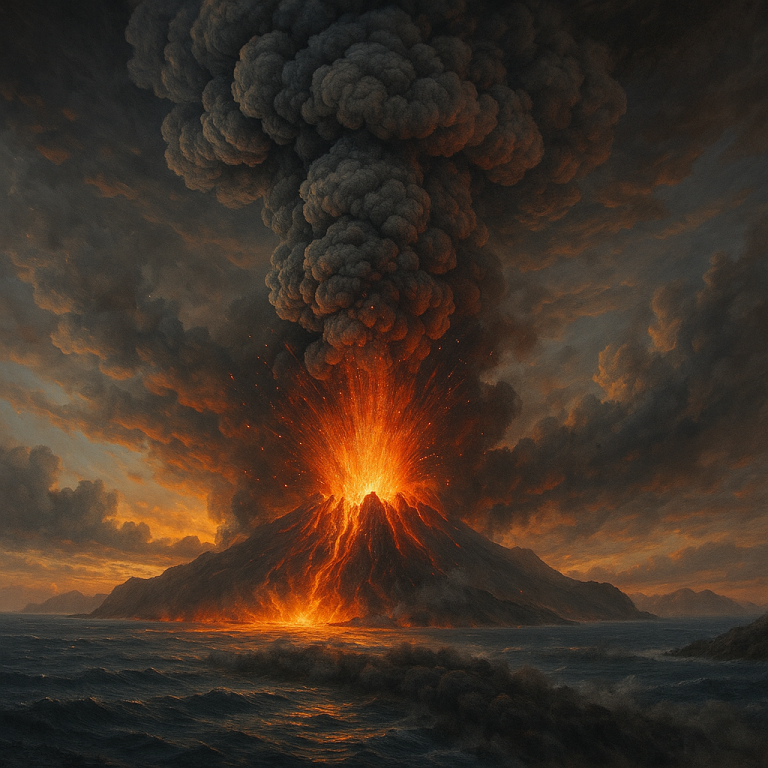
If you drew a line connecting the world’s most dangerous volcanoes, you’d trace a horseshoe 40,000 kilometres long around the Pacific Ocean. This isn’t coincidence. It’s the most geologically violent boundary on Earth, where tectonic plates collide, subduct, and tear apart with enough force to reshape continents.
The Pacific Ring of Fire hosts roughly 452 volcanoes, about three-quarters of all active and dormant volcanoes on the planet. It’s also responsible for approximately 90% of the world’s earthquakes and nearly all of the largest ones. If there’s a place where Earth’s internal violence breaks through to the surface, it’s here.
The ring isn’t actually circular. It’s a series of convergent plate boundaries where oceanic crust plunges beneath continental or other oceanic plates in a process called subduction. As plates descend into the mantle, water trapped in minerals is released, lowering the melting point of surrounding rock and generating magma. That magma, less dense than the rock around it, rises toward the surface. Where it breaks through, volcanoes form.
Start in South America. The Nazca Plate subducts beneath the South American Plate along the Peru-Chile Trench, creating the Andean Volcanic Belt. This arc includes some of the world’s highest volcanoes: Ojos del Salado at 6,893 metres, Llullaillaco at 6,739 metres, and dozens of others exceeding 5,000 metres. These aren’t dormant relics. Many remain active, their eruptions complicated by high altitude, glaciers, and the logistical challenges of monitoring volcanoes in remote mountain ranges.
Move north through Central America where the Cocos Plate subducts beneath the Caribbean Plate. Guatemala, El Salvador, Nicaragua, and Costa Rica form an almost continuous volcanic chain. Populations here live directly on volcanic flanks because the soil is too fertile to abandon. Cities like Guatemala City and San Salvador exist within hazard zones of multiple active volcanoes, creating scenarios where millions face potential risk from eruptions, lahars, and volcanic earthquakes.

North America’s contribution includes the Cascade Range stretching from northern California through Oregon and Washington into British Columbia. Mount St. Helens’ 1980 eruption demonstrated what these volcanoes are capable of: a lateral blast that removed 400 metres from the summit, killed 57 people, and deposited ash across a dozen states. Mount Rainier, sitting 87 kilometres from Seattle and Tacoma, represents an even larger threat due to its glacial mass and proximity to population centres.
The Aleutian Islands arc westward from Alaska in a chain of over 40 active volcanoes. This is where the Pacific Plate begins its descent beneath the North American Plate. The islands are sparsely populated, but eruptions here regularly disrupt North Pacific air traffic, as volcanic ash at altitude can destroy jet engines. Cleveland, Pavlof, and Shishaldin erupt frequently enough that aviation warnings are routine.
Kamchatka Peninsula in Russia’s Far East hosts 29 active volcanoes, the highest concentration anywhere along the ring. Here the Pacific Plate subducts beneath the Okhotsk Plate in one of the most volcanically intense regions on Earth. Klyuchevskaya Sopka, Eurasia’s tallest active volcano at 4,754 metres, erupts almost continuously. Shiveluch regularly produces ash plumes exceeding 10 kilometres altitude. Bezymianny’s 1956 eruption provided the template for understanding how volcanic edifices can catastrophically collapse.
The Kuril Islands, disputed between Russia and Japan, continue the arc southward. Then Japan itself, where four tectonic plates converge. The Pacific and Philippine Sea plates subduct beneath the Okhotsk and Amurian plates, creating Japan’s 110 active volcanoes. Mount Fuji last erupted in 1707 but sits just 100 kilometres from Tokyo, making it one of the world’s most closely monitored volcanoes. Sakurajima in southern Kyushu erupts thousands of times annually, coating nearby Kagoshima in ash so regularly that residents treat it as weather rather than disaster.
The Izu-Bonin-Mariana arc extends south from Japan through a chain of largely submarine volcanoes. This is where the Pacific Plate subducts beneath the Philippine Sea Plate at the Mariana Trench, Earth’s deepest point. Many of these volcanoes never breach the surface, erupting kilometres underwater where only research vessels and remote sensors detect them.
The Philippines sits where multiple subduction zones converge. Mayon, with its near-perfect cone, erupts regularly. Taal, one of the world’s most dangerous volcanoes, sits on an island within a lake within an island, surrounded by millions of people. Pinatubo’s 1991 eruption injected 20 million tonnes of sulphur dioxide into the stratosphere, causing measurable global cooling for two years.
Indonesia dominates the southern portion of the ring with over 130 active volcanoes, more than any other nation. The Indo-Australian Plate subducts beneath the Eurasian Plate along the Sunda Trench, creating the volcanic arc that stretches from Sumatra through Java, Bali, and eastward to Papua. Krakatau’s 1883 eruption generated tsunamis that killed over 36,000 people. Tambora’s 1815 eruption, the largest in recorded history, caused global climate disruption and the “year without a summer.” Merapi erupts so regularly that millions live on its flanks despite repeated evacuations.
New Zealand marks the southwestern terminus where the Pacific Plate subducts beneath the Indo-Australian Plate. The volcanic arc includes the frequently active White Island, Ruapehu with its crater lake, and the massive Taupo caldera that produced one of history’s largest eruptions around 180 CE.
The Ring of Fire isn’t just about volcanoes. The same tectonic processes generate massive earthquakes. The 1960 Chile earthquake measured magnitude 9.5, the largest ever recorded. The 1964 Alaska earthquake reached 9.2. The 2011 Tōhoku earthquake and tsunami in Japan killed over 18,000 people and triggered the Fukushima nuclear disaster. These megathrust earthquakes occur where subducting plates stick and then suddenly slip, releasing centuries of accumulated stress in seconds.
Roughly 450 million people live within the Ring of Fire’s volcanic threat zones. They stay because volcanic soils are extraordinarily fertile, coastal access supports fishing and trade, and geothermal resources provide energy. The Philippines, Indonesia, and Japan alone account for over 300 million people living in active volcanic regions. Evacuating isn’t an option. There’s nowhere for these populations to go, and the economic benefits of volcanic landscapes outweigh the periodic risks.
The ring will remain active indefinitely. Plate tectonics operates on timescales of millions of years. The Pacific Plate continues converging with surrounding plates at rates of several centimetres per year, generating the stress and magma that feed volcanic and seismic activity. As long as Earth’s interior remains hot and plates continue moving, the Ring of Fire will keep producing the eruptions and earthquakes that make it the planet’s most geologically dynamic zone.
Understanding this system isn’t academic. When Hunga Tonga-Hunga Ha’apai erupted in January 2022, the explosion was heard in Alaska, 9,000 kilometres away. The tsunami reached coasts around the entire Pacific. Modern monitoring systems tracked the atmospheric pressure wave as it circled Earth multiple times. That eruption, whilst not technically within the main Ring of Fire but in a related subduction zone, demonstrated how volcanic events in the Pacific basin can have global consequences.
The Pacific Ring of Fire is where geology becomes visceral, where theoretical plate tectonics manifests as mountains that explode and ground that tears itself apart. It’s where hundreds of millions of people have made the calculated decision that living on some of Earth’s most dangerous real estate is worth the risk. And it’s where the planet reminds us, repeatedly and violently, that the crust we live on is temporary, fragile, and subject to forces that don’t care about our cities, farms, or aspirations for stability.
References
Bluth, G. J. S., Doiron, S. D., Schnetzler, C. C., Krueger, A. J., & Walter, L. S. (1992). Global tracking of the SO₂ clouds from the June, 1991 Mount Pinatubo eruptions. Geophysical Research Letters, 19(2), 151-154. https://doi.org/10.1029/91GL02792
Daag, A. S., Tubianosa, B. S., Newhall, C. G., Tuñgol, N. M., Javier, D., Dolan, M. T., Delos Reyes, P. J., Arboleda, R. A., Martinez, M. L., & Regalado, T. M. (n.d.). Monitoring sulfur dioxide emission at Mount Pinatubo. U.S. Geological Survey. https://pubs.usgs.gov/pinatubo/daag1/
National Centers for Environmental Information. (2024, October 15). On this day: Historic Krakatau eruption of 1883. NOAA. https://www.ncei.noaa.gov/news/day-historic-krakatau-eruption-1883
National Centers for Environmental Information. (2025, May 16). On this day: 1960 Chilean earthquake and tsunami. NOAA. https://www.ncei.noaa.gov/news/day-1960-chilean-earthquake-and-tsunami
National Centers for Environmental Information. (2025, May 21). On this day: 2011 Tohoku earthquake and tsunami. NOAA. https://www.ncei.noaa.gov/news/day-2011-japan-earthquake-and-tsunami
National Geographic. (2021, May 3). Facts about the Ring of Fire. https://www.nationalgeographic.com/science/article/ring-of-fire
NOAA Ocean Exploration. (2020, December 17). What is the Ring of Fire? https://oceanexplorer.noaa.gov/facts/rof.html
Pletcher, K. (2011, March 11). Japan earthquake and tsunami of 2011. In Encyclopædia Britannica. https://www.britannica.com/event/Japan-earthquake-and-tsunami-of-2011
Smithsonian Institution. (n.d.). Krakatau. Global Volcanism Program. https://volcano.si.edu/volcano.cfm?vn=262000
Smithsonian Institution. (n.d.). Nevados Ojos del Salado. Global Volcanism Program. https://volcano.si.edu/volcano.cfm?vn=355130
Smithsonian Institution. (n.d.). What volcanoes and volcanic regions form the “Pacific Ring of Fire”? Global Volcanism Program. https://volcano.si.edu/faq/Pacific_Ring_of_Fire.cfm
U.S. Geological Survey. (n.d.). Because you care, be aware and prepare. Cascades Volcano Observatory. https://www.usgs.gov/observatories/cvo/because-you-care-be-aware-and-prepare
U.S. Geological Survey. (n.d.). Krakatau 1883. https://www.usgs.gov/node/176754
U.S. Geological Survey. (1997). The cataclysmic 1991 eruption of Mount Pinatubo, Philippines (Fact Sheet 113-97). https://pubs.usgs.gov/fs/1997/fs113-97/
Zimmermann, K. A. (2008, April 4). Chile earthquake of 1960. In Encyclopædia Britannica. https://www.britannica.com/event/Chile-earthquake-of-1960