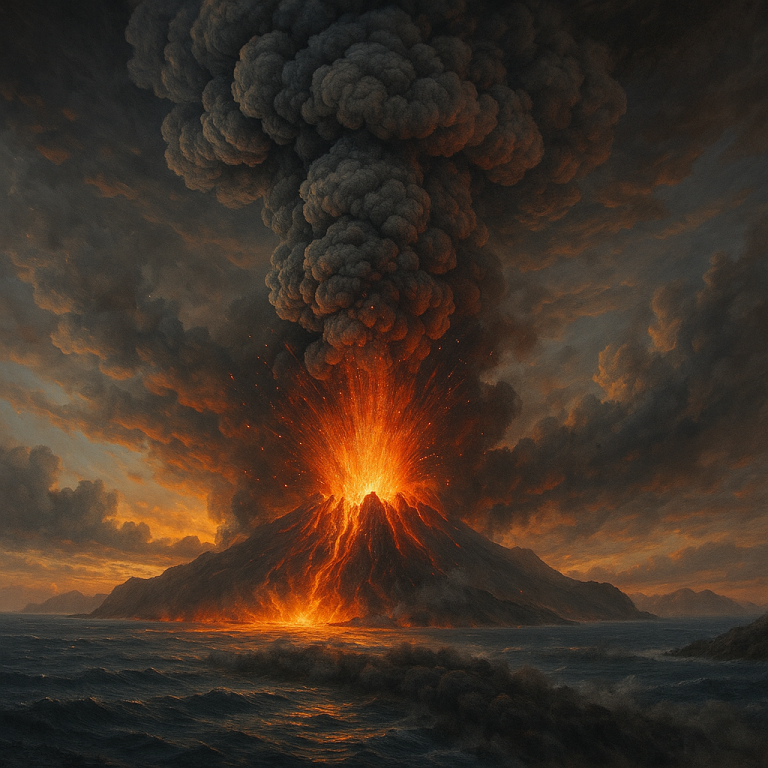
In 1737, Russia had been in Kamchatka for scarcely four decades. The fur trade had drawn Cossacks and settlers eastward across Siberia to this remote volcanic peninsula jutting into the Pacific. They had established a handful of outposts, subjugated the indigenous Itelmen population, and were beginning to exploit the region’s remarkable sea otter and fur seal populations. Then Avachinsky, a volcano looming over what would become their largest settlement, began what would become a four year eruption sequence that nearly convinced Russia to abandon the peninsula entirely.
The eruption started in autumn 1737 with increased seismic activity that the Russian settlers, unfamiliar with volcanic phenomena, initially attributed to earthquakes. The Itelmen knew better. Their oral traditions contained accounts of previous eruptions, and the elders recognised the signs. According to fragmentary records from the period, indigenous communities began moving away from the volcano before the Russians understood what was happening.
When Avachinsky finally erupted in earnest, it did so with a violence that stunned the colonisers. Explosions sent ash columns kilometres into the air. Pyroclastic flows descended the flanks, and lahars generated by melting snow and ice roared down valleys toward the coast. Russian settlements sat far enough from the volcano to avoid direct destruction, but ash fall blanketed the area in a grey coating that ruined what little agriculture the Russians had managed to establish on the peninsula.
The eruption did not stop. Through 1738, 1739, and into 1740, Avachinsky continued its assault. Periods of explosive activity alternated with lava effusion and persistent ash emissions. Each phase brought new hazards. Lahars swept down river valleys during heavy rains, making travel dangerous and destroying fish drying racks the settlers depended on for winter food supplies. Ash contaminated water sources. The continuous seismic activity damaged the wooden structures of Russian outposts.

Contemporary accounts, preserved in reports sent back to authorities in Yakutsk and eventually St Petersburg, describe conditions bordering on desperation. Russian commanders wrote of supplies running low, buildings damaged by earthquakes, and the native population’s reluctance to trade when volcanic unrest made hunting and fishing treacherous. The sparse Russian presence in Kamchatka, distributed across several small settlements, found itself struggling to maintain basic survival whilst the volcano continued its prolonged paroxysm.
The indigenous Itelmen suffered far worse than the Russian colonisers. Their settlements sat closer to the volcano, their economies were more directly tied to local resources affected by ash fall and lahars, and they lacked the option of retreat that the Russians theoretically possessed. Entire villages were abandoned. Population estimates for the Itelmen, already declining due to Russian colonisation and introduced diseases, dropped sharply during this period. Whether deaths resulted directly from the eruption or indirectly from starvation and displacement remains unclear from the fragmentary records.
The eruption’s impact extended beyond immediate physical destruction. The fur trade, Russia’s primary economic interest in Kamchatka, collapsed temporarily. Sea otters and fur seals, already under pressure from overhunting, became even scarcer as their coastal habitats were disrupted. The eruption dumped ash and debris into Avacha Bay, altering water chemistry and affecting fish populations. Hunters venturing into volcanic terrain risked injury from unstable ground, toxic gases, and the unpredictable nature of ongoing eruptive activity.
By 1740, serious discussions were occurring in Russian administrative circles about whether maintaining a presence in Kamchatka was worthwhile. The peninsula was already marginal from a colonial perspective, extraordinarily remote, difficult to resupply, inhabited by a small indigenous population offering limited tribute, and economically viable only for the fur trade. Add an active volcano destroying infrastructure and making the region even more inhospitable, and the cost benefit calculation shifted dramatically.


What kept Russia in Kamchatka was not the peninsula’s intrinsic value but its strategic position. The region offered one of the few ice free harbours in Russia’s Pacific territories. Abandoning it would cede Pacific access to potential rivals. The prestige factor mattered too. Russia had invested heavily in expanding eastward, and retreat from Kamchatka would represent a significant loss of face. It was during the final year of the eruption, in October 1740, that Vitus Bering arrived in Avacha Bay aboard the packet boats St Peter and St Paul, establishing the settlement of Petropavlovsk as the base for his Second Kamchatka Expedition. The timing was fortuitous, the volcanic crisis passing just as Russia’s most ambitious Pacific expedition arrived to demonstrate renewed imperial commitment to the region.
The eruption finally waned in 1741, though minor activity continued sporadically. By this point, the region had survived four years of volcanic assault, though barely. The population had declined, infrastructure needed rebuilding, and the local economy was devastated. Recovery took years, aided somewhat by Bering’s Second Kamchatka Expedition, which despite its disastrous conclusion—Bering died on Bering Island in December 1741—had brought resources and attention to the region.
The long term impact of the 1737 to 1741 eruptions shaped how Russians approached settlement in Kamchatka. Future development focused on areas with marginally better volcanic risk profiles, though genuinely safe locations simply do not exist on the peninsula. The eruptions demonstrated that Kamchatka would never support large scale agriculture, reinforcing the region’s dependence on fishing, hunting, and eventually geopolitical strategy rather than economic productivity.
For the Itelmen, the eruptions accelerated a population collapse already underway due to Russian colonisation. The combination of volcanic disaster, introduced diseases, forced labour, and cultural disruption reduced the Itelmen from an estimated twelve thousand to fifteen thousand at first contact to just a few thousand by the mid eighteenth century. The 1737 to 1741 eruptions hit during this vulnerable period, removing communities from their traditional territories and forcing survivors into closer contact with Russian settlements where disease transmission accelerated.
Modern volcanologists studying Avachinsky’s eruptive history have used these historical accounts, imprecise as they are, to understand the volcano’s behaviour. The four year duration suggests a substantial magma intrusion, possibly comparable in volume to the 1945 eruption but spread over a much longer period. The descriptions of lahars, ash fall, and explosive activity are consistent with the volcano’s known eruptive style. Avachinsky has erupted at least sixteen times since 1737, with the most powerful historical eruption occurring in 1945 when it ejected approximately 0.25 cubic kilometres of tephra.
What is sobering is imagining that same eruption sequence today. Petropavlovsk Kamchatsky now has over 180,000 residents. The city hosts Russia’s Pacific Fleet, critical port infrastructure, an international airport, and serves as Kamchatka’s administrative and economic centre. A four year eruption comparable to 1737 to 1741 would be catastrophic, likely forcing at least partial evacuation and causing economic damage measured in billions of rubles. The city sits approximately thirty kilometres from the volcano, close enough to receive significant ash fall and to be threatened by lahars channelled down valleys toward Avacha Bay.
The 1737 to 1741 eruptions represent one of those historical moments where geology nearly redirected human history. Had Avachinsky’s assault been slightly more intense, or had it continued another year or two, Russia might have concluded that maintaining a Kamchatka presence was not viable. The Pacific Fleet would be based elsewhere, the peninsula might have remained primarily indigenous territory, and Russia’s entire eastern frontier would look different.

Instead, the Russians endured, rebuilt, and embedded themselves so deeply in Kamchatka that volcanic risk became simply another accepted reality of life at the edge of empire. Avachinsky kept erupting periodically, and people kept living beneath it, a pattern that continues today with far higher stakes and far more people betting their lives that the volcano’s next major eruption will not be as bad as 1737, or worse. In 1996, Avachinsky and neighbouring Koryaksky were designated Decade Volcanoes by the International Association of Volcanology and Chemistry of the Earth’s Interior, recognition of both their scientific importance and the significant population at risk.
The story of Avachinsky’s eighteenth century eruption cycle offers a sobering reminder that volcanic crises unfold on timescales inimical to human patience. Four years of continuous volcanic assault would test any modern society’s resilience, let alone a marginal colonial outpost operating at the limits of logistics and survival. That Russia chose to persist rather than retreat speaks both to imperial determination and to the uncomfortable truth that once you commit to a place, retreat becomes psychologically more difficult than endurance, even when geology makes it clear you have chosen poorly.
Key Facts
📍 Location: Kamchatka Peninsula, 30 kilometres from Petropavlovsk Kamchatsky
⛰️ Elevation: 2,741 metres
🌋 Type: Stratovolcano
💨 Eruption period: 1737 to 1741 (four years)
🔥 Historical eruptions: At least 16 since 1737
📊 Major eruption: 1945 (VEI 4, 0.25 cubic kilometres tephra)
📅 Recent activity: 1991, 2001, 2008
🔬 Status: Active, designated Decade Volcano (1996)
⚠️ Population at risk: Over 180,000 in Petropavlovsk Kamchatsky
References
Girina, O. A. (2013). Chronology of Avachinsky volcano activity (Kamchatka) from 1737 to 2012 by historical and satellite data. Journal of Volcanology and Seismology, 7(5), 3 1 1–324. https://doi.org/10.1134/S0742046313050035
Global Volcanism Program. (2013). Avachinsky (Volcano number 300100). Smithsonian Institution. https://volcano.si.edu/volcano.cfm?vn=300100
Melekestsev, I. V., Braitseva, O. A., & Ponomareva, V. V. (1995). Dynamics of volcanic activity in the Kuril-Kamchatka region of the Pacific volcanic belt. Petrology, 3(5), 461–473.
Muravyev, Y. D., Ovsyannikov, A. A., Shiraiwa, T., & Matsuoka, K. (2007). Dynamics of the mass balance of snow-ice cover and glaciers on active volcanoes of Kamchatka. Zeitschrift für Geomorphologie, 51(1), 95–108. https://doi.org/10.1127/0372-8854/2007/0051-S1-0095
Viccaro, M., Giuffrida, M., Nicotra, E., Ozerov, A. Y., & Schiano, P. (2012). Magma storage, ascent and recharge history prior to the 1991 eruption at Avachinsky Volcano, Kamchatka, Russia: Inferences on the plumbing system geometry. Lithos, 140–141, 11–24. https://doi.org/10.1016/j.lithos.2012.01.019
Zelenski, M., Taran, Y., & Galle, B. (2015). High emission rate of sulfurous gas from Bezymianny volcano, Kamchatka. Geophysical Research Letters, 42(18), 7005–7013. https://doi.org/10.1002/2015GL065340
Copyright © Tales from the Horizon, 2025