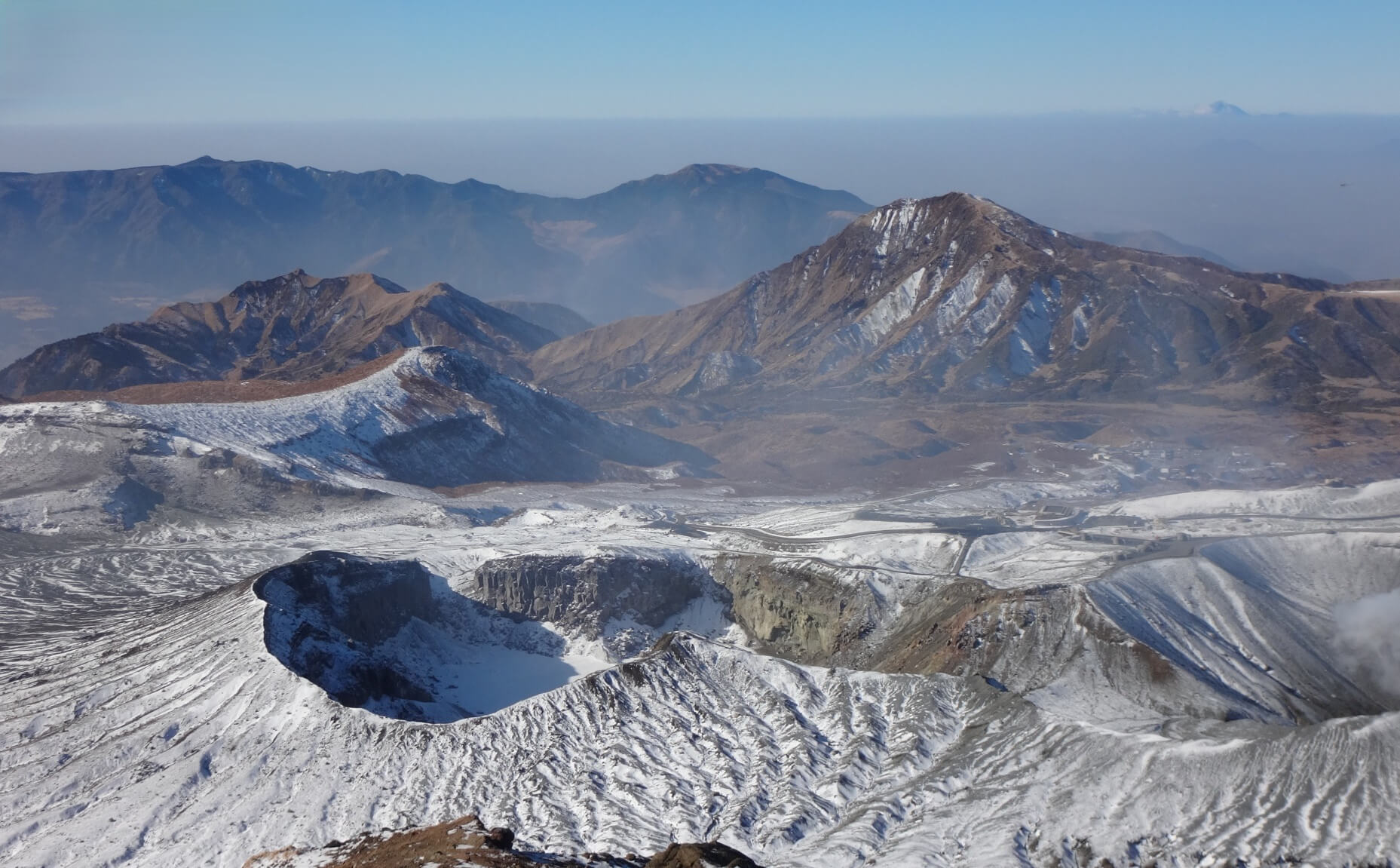
Stand on the northern rim of Aso caldera on a clear winter morning, when frost rimes the grass and the breath of fumaroles rises white against a cobalt sky, and you confront a paradox written in stone and ash. Below stretches a pastoral landscape of remarkable tranquility: farmland stitched in greens and browns, villages nestled in valleys, roads threading between rice paddies. Children cycle to school. Smoke rises from breakfast fires. Life proceeds with the ordered rhythm of human domesticity.
Yet this peaceful tableau rests upon the collapsed roof of one of Earth’s most devastating volcanic systems: a caldera carved not by gradual erosion but by cataclysm, hollowed out when the mountain’s innards were expelled with such violence that the sky above Japan turned to perpetual dusk, and ash fell like snow across an entire island nation.
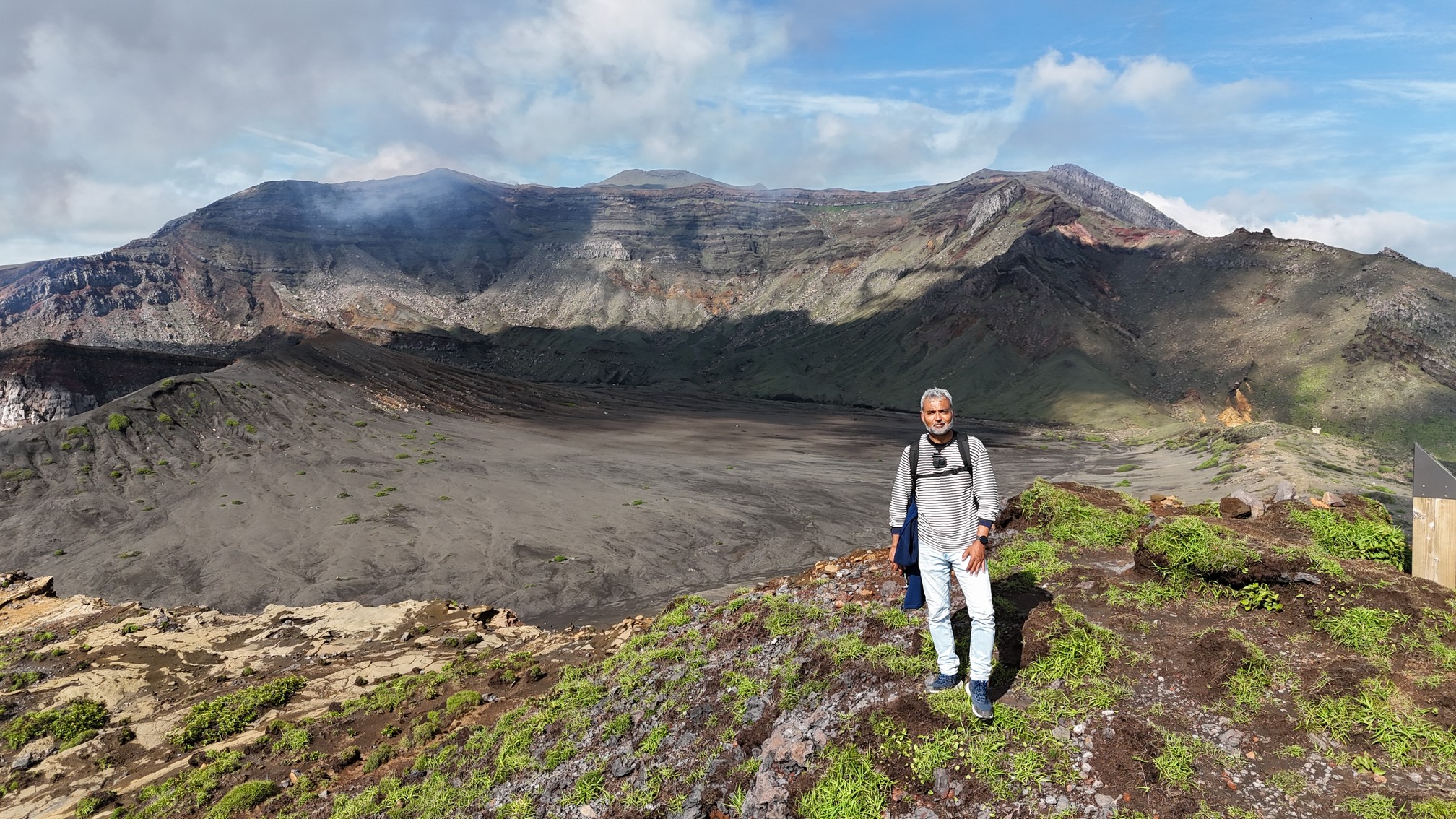
Mount Aso, in the heart of Kyushu, is not a singular peak but a vast volcanic complex, a twenty-five-kilometer scar in the landscape where catastrophe and creation have danced their ancient gavotte for hundreds of millennia. The caldera stretches nearly as wide as metropolitan Tokyo, a testament not to what remains but to what was obliterated. Geological reconstructions suggest that before the great collapses, a massive composite cone dominated this region: imagine a mountain rivaling Fuji in symmetry and grandeur, built patiently through hundreds of thousands of years of lava flows and moderate explosive eruptions. That pre-caldera edifice would have towered over central Kyushu, a landmark visible from the coasts, its snow-capped summit a compass point for early peoples navigating the island.
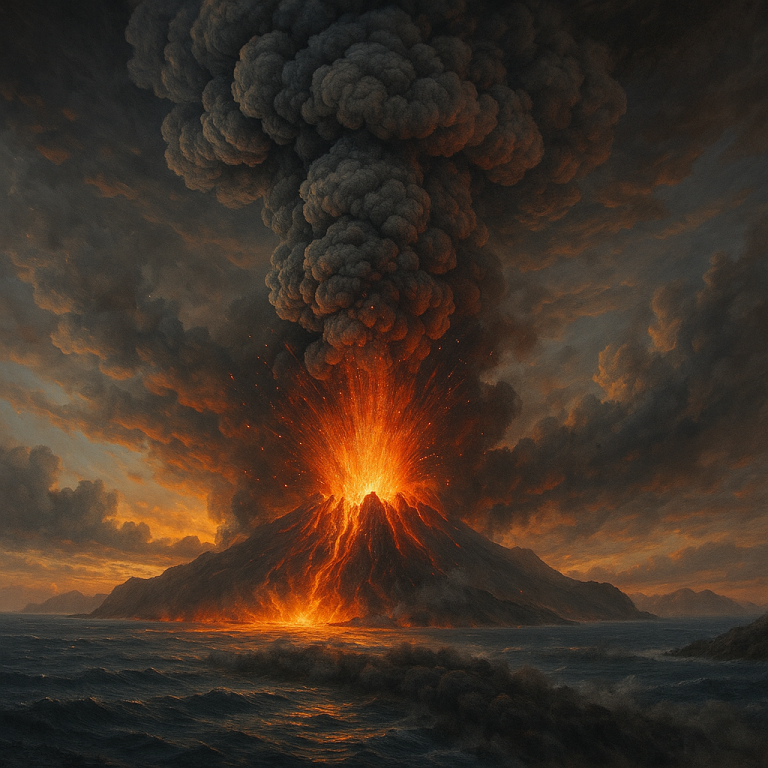
Then came the fire.
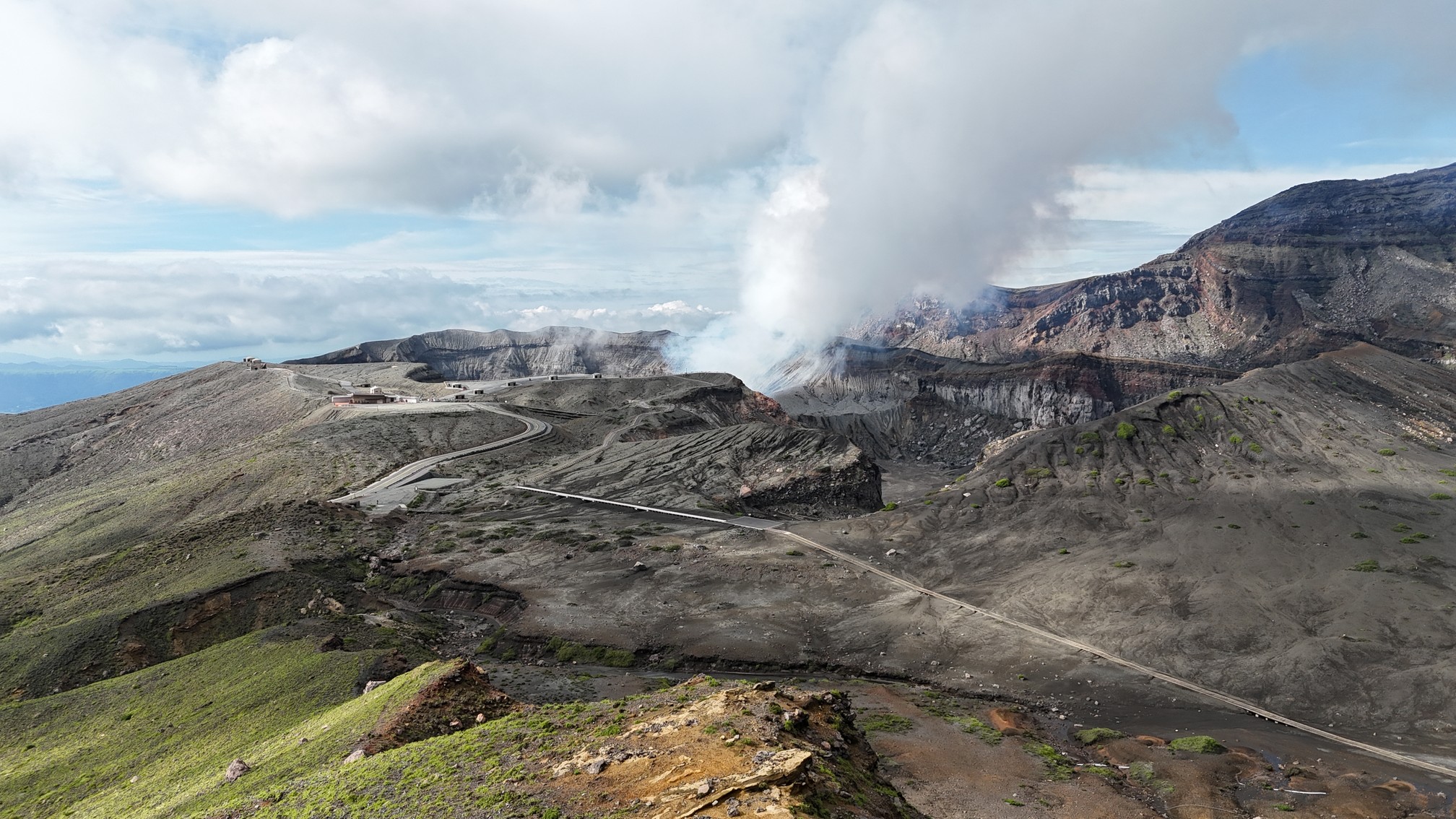
Within the caldera’s embrace now rise five peaks (the Aso Gogaku, or “Five Mountains of Aso”) survivors and descendants of the volcanic paroxysms that shaped this landscape. Takadake, at 1,592 meters, stands highest. Nekodake (1,433 meters) cloaks itself in autumn colors that draw leaf-peepers from across Japan, its slopes somehow having survived not one but two caldera-forming eruptions. Nakadake (1,506 meters) continues the restless work, its summit crater breathing sulfurous fumes and occasionally coughing out ash plumes that dust the surrounding countryside. Eboshidake (1,337 meters) and Kishimadake (1,321 meters) complete the quintet, each a monument to the volcano’s continuing, if diminished, vitality.
The Four Horsemen of Aso
Aso’s claim to the dreaded designation of “supervolcano” (a term reserved for those rare beasts capable of reshaping continents) rests upon a quartet of monstrous eruptions that punctuate its geological biography. These events, numbered prosaically as Aso-1 through Aso-4, mark a sequence of catastrophes that progressively excavated the caldera we see today, each blast widening the wound until the final cataclysm produced a depression large enough to swallow a small city.
The cycle began approximately 266,000 years ago with Aso-1, the opening salvo in a campaign of destruction that would span nearly two hundred thousand years. Though the smallest of the quartet, Aso-1 was hardly modest: it expelled some thirty-two cubic kilometers of magma in dense-rock equivalent, achieving a Volcanic Explosivity Index rating of 7 (“super-colossal” in the parlance of volcanology). Picture a cube of molten rock, each edge stretching more than three kilometers, suddenly transformed into incandescent clouds of ash and pumice that scoured the landscape. Rivers choked with debris. The sky turned the color of rust. And when the fires cooled and the ash settled, a caldera had been born.
Aso-2 followed roughly 141,000 years ago, another VEI 7 event releasing a similar volume of pyroclastic fury. The ash layers from this eruption can still be traced in soil profiles across western Japan, gray bands of compressed pumice that geologists read like tree rings, each stratum a page in Earth’s autobiography. Between these paroxysms, the volcano likely behaved much as it does today: steaming, grumbling, occasionally spitting out small eruptions that would have terrified any humans unfortunate enough to witness them, had humans yet arrived in these latitudes.
Then, approximately 120,000 to 130,000 years ago, Aso escalated. The Aso-3 eruption released over ninety-six cubic kilometers of dense-rock equivalent, triple the volume of its predecessors. Pyroclastic flows careened forty to sixty kilometers from source, incinerating everything in their path and leaving behind sheets of welded tuff that still blanket portions of Kyushu. The ignimbrites from Aso-3 are remarkable in their extent and violence, but they were merely a prelude, a warmup for the main event.
The Aso-4 Cataclysm: When Mountains Became Ghosts
What occurred 87,000 to 89,000 years ago defies easy comprehension. Even using the language of volcanology (with its cubic kilometers and eruptive magnitudes, its pyroclastic density currents and dense-rock equivalents) fails to convey the sheer planetary violence of the Aso-4 eruption.
Recent forensic volcanology, employing thousands of borehole samples, geological maps, and submarine tephra cores, has revised our understanding of Aso-4’s magnitude. The total eruptive volume now stands estimated at between 930 and 1,860 cubic kilometers, with a best estimate around 465 to 962 cubic kilometers in dense-rock equivalent. To put this in perspective: if you melted every building, road, and structure in Greater Tokyo and compressed it into solid rock, you would approach the lower bound of what Aso-4 expelled. The eruptive mass reached between 1.2 and 2.4 × 10^15 kilograms—that’s 1.2 to 2.4 quadrillion kilograms of magma transformed in hours or days into a maelstrom of pyroclastic flows, ash columns, and co-ignimbrite clouds.
This places Aso-4 firmly in VEI 8 territory (the highest category on the Volcanic Explosivity Index, reserved for eruptions of truly geological consequence). It ranks as the largest volcanic event in Japan in the past million years and the second-largest eruption globally in the last 100,000 years, surpassed only by the Toba super-eruption that occurred in Sumatra approximately 74,000 years ago.
The mechanics of the eruption likely unfolded in multiple pulses. Aso-4’s pyroclastic deposits reveal at least eight distinct flow units, separated by cooling breaks and changes in welding degree. Each pulse would have been a catastrophe in its own right: superheated density currents racing across the landscape at hurricane speeds, their bases glowing orange with incandescent particles, their tops boiling upward into columns that punched through the troposphere. The flows traveled with astonishing mobility—pyroclastic deposits from Aso-4 have been identified 166 kilometers north-northeast of the source, one of the longest runout distances ever documented for such flows. Even at these extreme distances, the deposits retain thicknesses of ten to fifteen centimeters, mute testimony to the energy that propelled them.
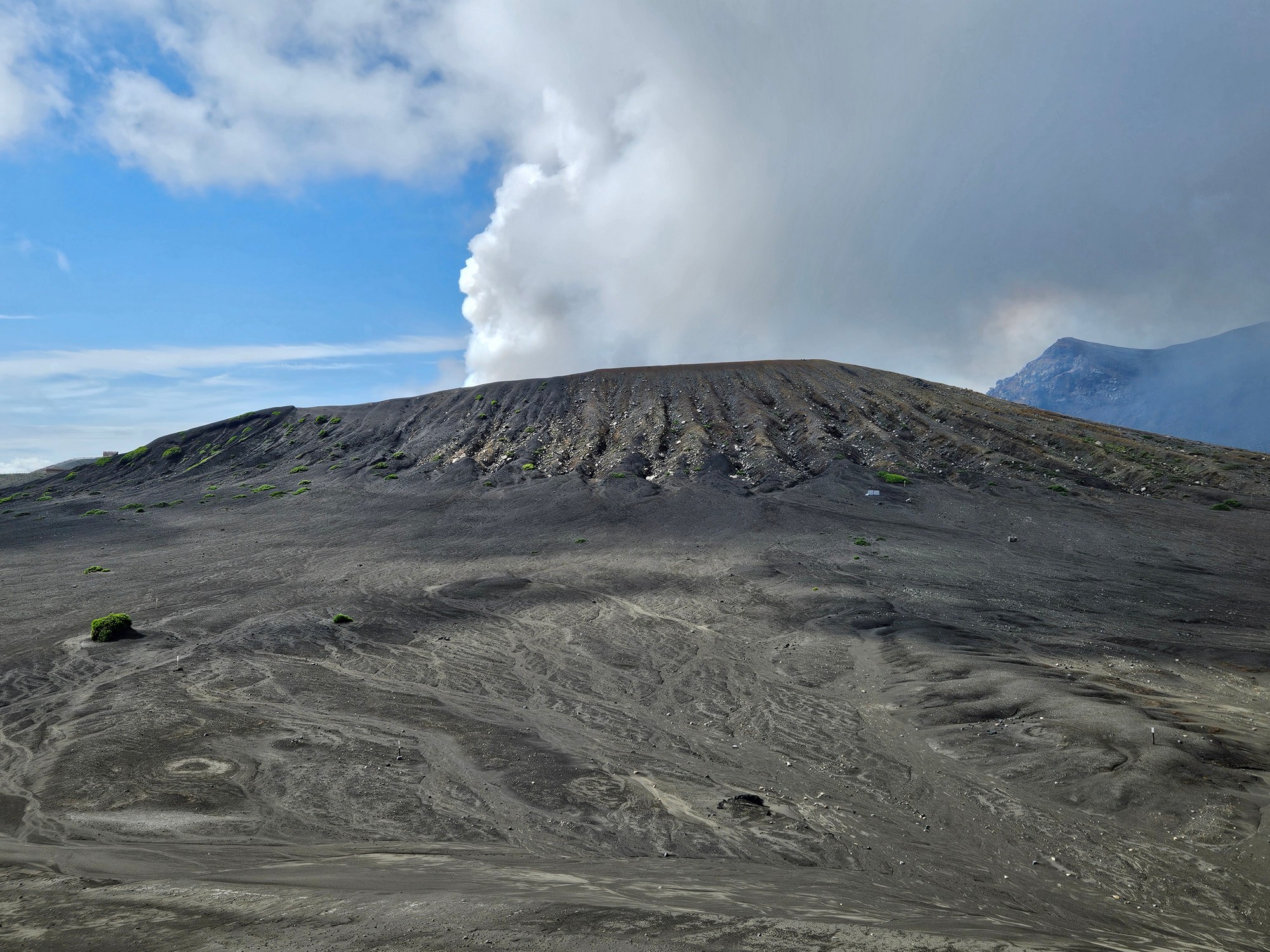
The ash fall was equally extraordinary. Co-ignimbrite clouds (formed as fine particles elutriated from the pyroclastic flows) rose to stratospheric heights, perhaps forty to sixty kilometers above the vent. From there, prevailing winds distributed ash across the entirety of Japan. Deposits fifteen centimeters thick have been identified in eastern Hokkaido, some 1,700 kilometers from Aso. Marine cores recovered from the seafloor surrounding Japan reveal the telltale geochemical signature of Aso-4 tephra, a marker horizon that allows precise dating of sedimentary sequences.
When the eruption finally exhausted itself (whether over days, weeks, or months, we cannot be certain) the landscape had been transformed utterly. The magma chamber, catastrophically evacuated, could no longer support the weight of the overlying rock. The summit and flanks of the composite cone collapsed downward, forming the caldera we observe today. Within this depression, thick sequences of densely welded ignimbrite accumulated, reaching depths of 400 meters or more. The heat stored in these deposits took decades, perhaps centuries, to dissipate, creating a landscape of fumaroles and hot springs that would have made the caldera floor uninhabitable for generations.
The Atmospheric and Climatic Aftermath
An eruption of Aso-4’s magnitude would not merely devastate the local landscape; it would leave fingerprints in global climate records. The injection of sulfur dioxide, hydrogen chloride, and other volatiles into the stratosphere creates aerosol veils that reflect incoming solar radiation, cooling the planet. While Aso-4 was not large enough to trigger a volcanic winter on the scale of the Toba event, it likely produced measurable cooling across the Northern Hemisphere, disrupting monsoons and altering precipitation patterns for years following the eruption.
The ashfall blanketing Kyushu and beyond would have created secondary hazards for millennia. Interaction with rainfall would have generated countless lahars (volcanic mudflows) that scoured valleys and choked rivers. The tephra layers, initially unconsolidated, would have been mobilized by every heavy rain, extending the ecological damage far beyond the initial eruption.

The Restless Present
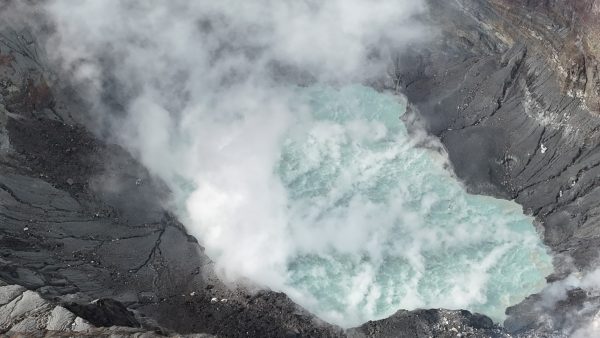
Today, Aso’s volcanic vigor concentrates itself at Nakadake, the active heart of the complex. Here, fumaroles hiss and wheeze with the breath of the underworld, and a crater lake shifts from turquoise to milky gray as the chemistry of gases below fluctuates with the volcano’s mood. Nakadake has erupted more than 170 times since written records began in 553 CE, making it one of Japan’s most consistently active vents. Recent eruptions in 2014, 2015, 2016, and 2021 remind us that Aso’s story is far from concluded.
Stand at the crater rim (accessible by toll road, a testament to either human courage or hubris) and peer into Nakadake’s maw. Steam rises from vents in the crater walls. The lake roils gently. Sulfur stains the rocks yellow and orange. The air smells of rotten eggs and carries a metallic tang. This is not a dormant museum piece but a living, breathing system, connected by subterranean plumbing to magma chambers kilometers below.
Geophysical studies reveal the architecture of Aso’s underworld: a funnel-shaped structure in the bedrock beneath the caldera, magma pathways dipping northward from depth, shallow reservoirs at two to four kilometers feeding Nakadake’s surface activity. Crucially, current monitoring detects no signs of the massive magma accumulation that would herald another caldera-forming event: no “Aso-5” appears imminent on human timescales. The volcano, it seems, remains in what researchers term the “recovery phase” of its caldera cycle, a period of modest effusive and explosive activity following a super-eruption.
Yet complacency would be foolish. A hundred thousand people live within Aso caldera, farming the rich volcanic soils, running inns that cater to tourists seeking onsen waters heated by the volcano’s residual warmth. Tens of thousands more dwell on the caldera flanks and in surrounding valleys. Should Nakadake’s activity intensify beyond its current sputtering, evacuation plans exist, honed through decades of managing a restless neighbor. The Japanese have learned to coexist with their fire mountains, balancing the hazards against the benefits these volcanoes provide: fertile soils, geothermal energy, spiritual significance, and a landscape of undeniable majesty.
Reflections from the Rim
Standing on Aso’s northern rim as afternoon light slants across the caldera, it becomes possible (just barely) to imagine the mountain that once was. Picture the composite cone restored, a symmetrical giant dominating the skyline. Picture the magma chamber beneath slowly filling, pressure building, the mountain swelling almost imperceptibly as cubic kilometers of molten rock accumulate in the crust. Picture the warnings: small earthquakes, heightened fumarolic activity, perhaps a Plinian eruption or two as a prelude. And then picture the main event: the sky turning black at noon, pyroclastic flows overtopping the caldera rim, ash clouds boiling upward until they brush the mesosphere, and the ground itself collapsing as millions of tons of rock and magma are expelled in a geological eyeblink.
We live, thankfully, in an epoch when such super-eruptions are rare. The last VEI 8 event, Toba, occurred more than seven times longer ago than all of recorded human history. But Aso reminds us that these catastrophes are not mythological abstractions but documented realities, events that reshaped landscapes and possibly influenced human evolution and migration. The ash layers buried in Japan’s soils are not academic curiosities but evidence of apocalypse, chapters in a narrative that stretches back hundreds of thousands of years and will continue for hundreds of thousands more.
For now, Nakadake steams and grumbles, the farmers tend their fields, and tourists queue for the cable car to the crater rim. Life proceeds in the shadow of supervolcano, as it has for millennia, as it will continue until Earth’s interior decides otherwise. Aso caldera is a reminder, written in ignimbrite and ash, that our planet remains a fundamentally volcanic world, that the forces which created the continents and oceans continue their slow, inexorable work, and that we humans (for all our technologies and civilizations) remain guests in a house whose foundations are molten and whose roof can cave in with terrifying speed when conditions align.
The mountain, as the Japanese say, is patient. It can wait.
References
Hoshizumi, H., Ono, K., Mimura, K., & Noda, T. (1988). Geology of the Beppu District. Quadrangle Series, 1:50,000. Geological Survey of Japan.
Kaneko, K., Kamata, H., Koyaguchi, T., Yoshikawa, M., & Furukawa, K. (2007). Repeated large-scale eruptions from a single compositionally stratified magma chamber: An example from Aso volcano, Southwest Japan. Journal of Volcanology and Geothermal Research, 167(1-4), 160-180. https://doi.org/10.1016/j.jvolgeores.2007.05.002
Keller, J., Furukawa, K., & Ishikawa, K. (2023). Tracking caldera cycles in the Aso magmatic system—Applications of magnetite composition as a proxy for differentiation. Journal of Volcanology and Geothermal Research, 437, 107813. https://doi.org/10.1016/j.jvolgeores.2023.107813
Machida, H., & Arai, F. (2003). Atlas of tephra in and around Japan (revised edition). University of Tokyo Press.
Matsumoto, A., Uto, K., Ono, K., & Watanabe, K. (1991). Ar-40/Ar-39 age determinations for the Handa and Yokkaichi pyroclastic flows of Aso volcano, southwestern Japan. Geochemical Journal, 25(3), 193-201.
Miyoshi, M., Sumino, H., Miyabuchi, Y., Shinmura, T., Mori, Y., Hasenaka, T., Furukawa, K., Uno, K., & Nagao, K. (2011). K-Ar ages determined for post-caldera volcanic products from Aso volcano, central Kyushu, Japan. Journal of Volcanology and Geothermal Research, 229-230, 64-73.
Ono, K., Matsumoto, Y., Miyahisa, M., Teraoka, Y., & Kambe, N. (1977). Geology of the Taketa district. Quadrangle Series, 1:50,000. Geological Survey of Japan.
Smithsonian Institution. (2021). Asosan. Global Volcanism Program. https://volcano.si.edu/volcano.cfm?vn=282110
Takarada, S., & Hoshizumi, H. (2020). Distribution and eruptive volume of Aso-4 pyroclastic density current and tephra fall deposits, Japan: A M8 super-eruption. Frontiers in Earth Science, 8, 170. https://doi.org/10.3389/feart.2020.00170
Watanabe, K. (1978). Studies on the Aso pyroclastic flow deposits in the region to the west of Aso Caldera, Southwest Japan, I: Geology. Memoirs of the Faculty of Education, Kumamoto University. Natural Science, 27, 97-120.
Watanabe, K. (1979). Studies on the Aso pyroclastic flow deposits in the region to the west of Aso Caldera, Southwest Japan, II: Petrology of the Aso-4 pyroclastic flow deposits. Memoirs of the Faculty of Education, Kumamoto University. Natural Science, 28, 75-112.
Copyright © Tales from the Horizon, 2025